lunes, 26 de marzo de 2018

Infinitive Clauses With Impersonal It


La expresión "It is a dj / noun to" enfatiza la información llevándola al frente de la cláusula. El sujeto de una cláusula de infinitivo se expresa opcionalmente como [para + sustantivo] o el pronombre acusative [para + propnoun].


Ejemplos:
  •          It is easy to find fault with others.
  •          It makes me angry to wait for people who are never punctual.
  •          It was his goal to become a well known writer.
  •          It is your duty to finish the work in time.


martes, 27 de febrero de 2018

TEMA 12


Verb + gerund/infinitive

El gerundio y el infinitivo son formas de los verbos que actúan como nombres. El gerundio se forma con “ing” (walking), el infinitivo es forma con la preposición “to” (to walk).


verbo
Gerundio
Infinitive
Avoid
x

Deny
x

Dislike
x

Enjoy
x

Finish
x

Continue

x
Deside

x
Hate
x
x
Like
x
x
Love
x
x
Start
x
x
Hope

x
Need

x
Prefer
x
x


Ejemplos

·       They decided to move to Australia in may.
·       Decidieron mudarse a Australia en mayo.
·       I enjoy listening to music.
·       Disfruto escuchando musica.
·       You live dancing
·       Te encanta bailar.
·       I tried to learn English.
·       He intentado aprender ingles.
·       I like to cook.
·       Me gusta cosinar.
·       Swimming is good exercise.
·       Nadir es un buen ejercicio.
·       Drining an driving is dangerous.
·       Beber y conducir es peligroso.
·       He’s good at listening.
·       Escucha bien.


TEMA 11


RELATIVE CLAUSES


Utilizamos los pronombres relativos para referirnos a un sustantivo (una persona o una cosa) mencionado antes y al que queremos agregar más información o modificar.
Los pronombres relativos pueden referirse a algo o a alguien en singular o plural.


pronombre
lugar
persona
momento
cosa
That/que

x

x
Which/que/cual


x
who

x


when


x

where
x


what


x


Ejemplos
That
  •    This is the book that won the Pulitzer.
  •        Este es el libro que gano el premio el año pasado.

Which
  •      The house which we lived in when we were children burnt down last week.
  •        La casa en la que vivíamos cuando éramos niños se quemó la semana pasada. 

Who
  •        My sister, who just moved in twith me, is looking for a job.
  •       Mi Hermana, que se acaba de mudar conmigo, está buscando trabajo.

When
  •   Can you tell me when is the best time to call?
  •       Puedes decirme cuando es la mejor hora para llamar?

Where
  •       The university where l teach is an excellent school.
  •       La Universidad donde enseño es una escuela excelente.

What
  •        What is the name of the man who live next door?
  •       Cuál es el nombre del hombre que vive al lado?


lunes, 29 de enero de 2018

TEMA 10

APRENDE INGLES 

Tag Questions


"Tag questions" son preguntas que se usan para confirmar lo que piensas que es verdad.


Para formar un "tag question" empiezas con la oración que piensas que es verdad ("You speak Spanish" en el ejemplo arriba). 

El "tag" (la parte de la oración que hace que sea una pregunta) se forma usando un verbo auxiliar en el negativo si la oración fue afirmativa o un verbo auxiliar en el afirmativo si la oración fue negativa. Ve los ejemplos en la tabla abajo.


EJEMPLOS


  • She doesn't read the newspaper every day, does she? ...
  • He doesn't walk to school, does he? ...
  • They don't play tennis on Sundays, do they? ...
  • You don't watch television every night, do you? ...
  • She doesn't want to learn French, does she?


TEMA 9


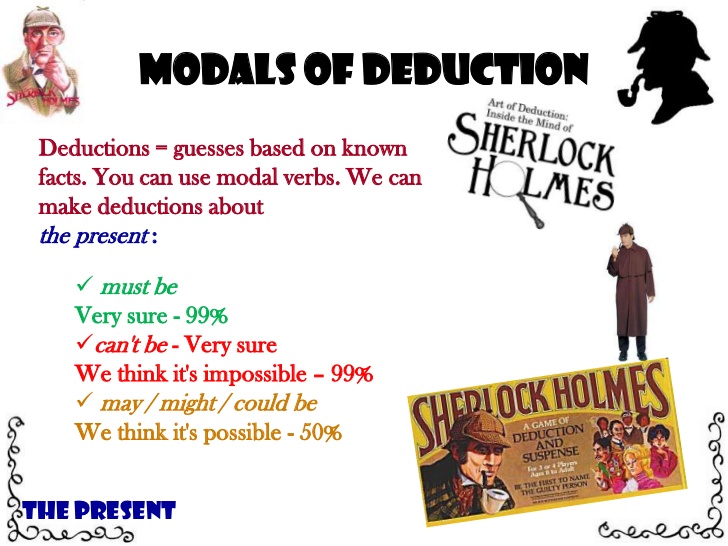
Modal verbs of deduction


may, might

 
We use may and might to talk about things that are possibly true, but we don’t know for sure. (Usamos may y might para hablar sobre cosas que no son posiblememte ciertas, pero no estamos seguros)

                                    Ejemplos
  • He’s more than 2 meters tall. He might be a basketball player. (=perhaps he is)
  • He says Betty is his friend, but I think she may be his girlfriend.
We use may not or might not to talk about things that are possibly not true, but we don’t know for sure.
  • You should call her. She might not know where you are. (=perhaps she doesn’t know)

must, can’t

 
We use must when we are sure, or quite sure, that something is true.(
Usamos must cuando estamos seguros, o bastante seguros, de que algo es cierto.)

      Ejemplos


  • You must be tired after the long journey. (=I’m sure you are tired)
  • I’m sure I had the keys when I left. They must be in the car.